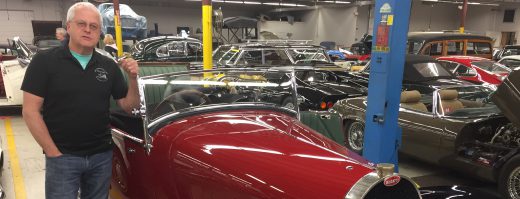
Bugatti Type 49
February 4th, 2012Here’s the latest at the Panel Shop in Stratford Connecticut.
Steve Hall is finishing up the details on a Bugatti Type 49 that’s now heading over for paint, and he gave a tour of the work he did on this car:
Here’s the latest at the Panel Shop in Stratford Connecticut.
Steve Hall is finishing up the details on a Bugatti Type 49 that’s now heading over for paint, and he gave a tour of the work he did on this car:
Here’s Mark talking about how he repaired a set of wheel arches on an Aston Martin DB4. These are done at The Panel Shop in Stratford CT.
Steve was putting on the finishing touches on the Proteus Jaguar we had the shop a few months ago. Here’s the video:
Mark talks about the work done to a Maserati Race car.
Here’s Mark explaining the work he’s done on a 1915 Hudson. They’re building a body from scratch from a buck they were delivered from the shop doing the restoration on the car.
Steve Hall showed what kind of work has to be done on a Proteus Jaguar. The Panel Shop has been brought in to finish all the little details in completingĀ a kit of this type.
Here’s our first You Tube video with Mark Barton showing some of the work needed before painting.
Someone recently asked about headlight covers and how we make custom plexiglas covers. I pointed them to a post we did a couple of years ago:

Some front nose parts were made for an Alfa Romeo including the front grille parts and headlight pieces.

In order to make new plexi-glass headlight covers, molds need to be made from aluminum.

New frames were made as well to secure the lenses.

Here are the plexi headlight covers made from our aluminum blanks.

With everything mounted and test fitted, it’s time for paint and finishing.

There are two Jaguar XK bodies in the shop going through some sheet metal repair. This body is laying upside down for easier access, but you can make out the familiar side vent on these cars. What might not be so obvious, however, is how much of a slight shape there is to the slab sides of a XK body. Getting these slight curves to line up with other panels takes more skill than it may seem.
Large sections for these bodies are available new, but sometimes it’s cheaper to have patches made, provided a skilled fabricator is on the job…

Here’s an example of a side panel repair gone horribly wrong. What began as a simple patch panel began to distort the large expanse of sheet metal. When the previous shop tried to shrink and stretch the deformed metal, it only got worse.

It looks like cuts were made to relieve the buckling sheet metal, then it was welded back together.
It got so bad that they even tacked in a stiffening piece behind the panel to try and control the warpage (top of the picture). They made up for lack of skill with a nice thick coat body filler and called it a day.

At a certain point, these repairs can only be salvaged with a new panel. Metal can only be worked so much before it becomes easier to start fresh. This panel was made in house by the Panel Shop.

A “new” piece of equipment arrived at the shop recently. Mark found a punch press for sale from a local shop. Having a machine capable of punching holes in sheet metal at “The Panel Shop” can offer limitless possibilities, and the first order of business is to set it up for making louvers. Mark and Steve have a hand operated press that made these louvers before, but having this machine makes it a much easier task.
The shape and the length of the louver is formed by a custom die and punch fabricated to fit this new machine.

An example of what “The Panel Shop” can do is this hood for an E-type lightweight Jaguar bonnet.

Speaking of Jaguar sheet metal, The Panel Shop also has rear boot lid and wing sections in aluminum for an E-type.